
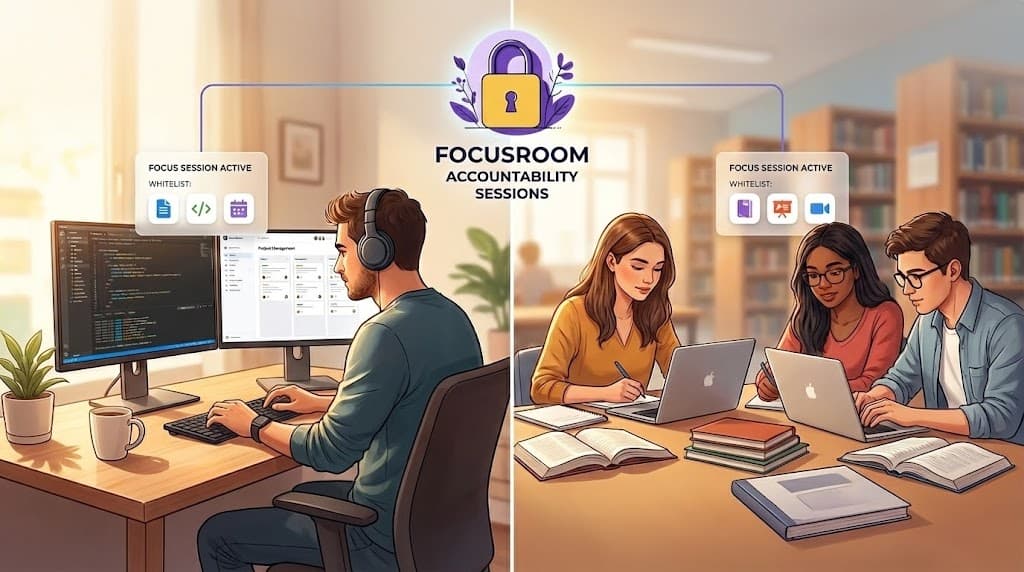
Working alone is hard.
Whether you're a freelancer at your kitchen table, a remote worker without coworkers, or a student preparing for exams in your bedroom—the struggle is the same: no one's watching, and distractions are everywhere.
You tell yourself you'll write for two hours. Then you check Twitter "for just a second." An hour later, you've doom-scrolled through a political argument and watched three YouTube videos about topics you'll forget by tomorrow.
Sound familiar?
Here's the secret that productive people have discovered: you don't need willpower—you need accountability.
The Freelancer/Student Focus Problem
When you work alone, you're fighting against your environment:
No external structure: There's no boss watching, no class schedule forcing you to show up, no coworkers who'll notice if you're browsing Reddit.
Unlimited distractions: Your work computer is also your entertainment device. The same browser that opens Google Docs opens Netflix.
Decision fatigue: Every moment is a choice between working and not working. Eventually, your willpower depletes, and distractions win.
Isolation amplifies procrastination: When no one knows what you're doing, there's no social pressure to actually do it.
The result? Freelancers work late nights to make up for unfocused days. Students cram at the last minute because they couldn't focus during planned study time. Everyone feels guilty about their productivity—even when they're technically "working."
What Are Accountability Sessions?
An accountability session (also called virtual coworking) is simple:
- You connect with one or more people (friends, peers, strangers)
- Everyone commits to focusing on their own work for a set period
- You work "together" even though you're doing different tasks
- The social presence keeps everyone accountable
Think of it like studying at a library or working at a coffee shop—except virtual.
The magic isn't in the tools or techniques. It's in the social contract: "We agreed to focus, so I won't let you down."
How It Works with Focus Room
Traditional accountability sessions rely purely on social pressure. But here's the problem: it's easy to agree to focus while secretly browsing social media in another tab.
Focus Room adds structure through whitelist-based focus:
Step 1: Create a Room
One person creates a focus room and sets up a whitelist of allowed sites. For a general productivity session, this might include:
- Google Docs, Notion, your writing tools
- Research sites relevant to your work
- Your project management tool
What's not allowed:
- Social media
- Video streaming
- News and entertainment sites
Step 2: Invite Your Accountability Partners
Share the room code with your study group, freelancer friends, or accountability partners. Everyone joins via a simple browser extension.
Step 3: Focus Together
During the session:
- You can only access whitelisted sites
- The room shows who's actively focused
- Violations (attempts to access blocked sites) are visible to everyone
Step 4: Debrief
After the session, share what you accomplished. Celebrate wins. Plan the next session.
Whitelist Strategies for Different Work
Your whitelist should match your work. Here are templates for common use cases:
Writing & Content Creation
docs.google.com
notion.so
grammarly.com
hemingwayapp.com
Your CMS or publishing platform
Research & Academic Work
scholar.google.com
jstor.org
Your university library
Google Docs / Word Online
Reference manager (Zotero, Mendeley)
Design & Creative Work
figma.com
canva.com
dribbble.com (for reference only)
Adobe Creative Cloud
Programming & Development
github.com
stackoverflow.com
Official documentation sites
Your IDE or cloud coding environment
General Freelance Work
Your project management tool
Client communication (email, Slack)
Google Workspace
Payment/invoicing platform
Pro tip: Be honest about what you actually need. If you "need" YouTube for research, maybe allow specific channels—or save research for after the focus session.
Study Group Use Case
For students, accountability sessions are game-changers—especially during exam season.
The Traditional Study Group Problem
You get together to study. Someone makes a joke. Someone checks their phone. Before you know it, you've been "studying" for two hours but mostly just chatting.
Study Sessions with Focus Room
Before the exam:
- Create a room with just your study materials whitelisted
- Everyone joins and agrees to focus for 50-minute blocks
- No phones, no social media, no "quick breaks" that turn into an hour
For group projects:
- Whitelist collaboration tools (Google Docs, Slides)
- Work simultaneously on shared documents
- The focus structure prevents one person from doing all the work while others scroll TikTok
For exam prep:
- Whitelist your LMS and study materials only
- Nothing else—not even "helpful" YouTube tutorials that become procrastination
Study Session Schedule
A popular format for study groups:
| Block | Duration | Activity |
|---|---|---|
| Focus 1 | 50 min | Deep work in focus room |
| Break | 10 min | Stretch, snack, quick chat |
| Focus 2 | 50 min | Deep work continues |
| Break | 10 min | Decompress |
| Focus 3 | 50 min | Final push |
| Debrief | 10 min | Share progress, plan next session |
Three hours of actually focused study beats six hours of distracted "study time."
The Psychology: Why Social Accountability Works
Accountability sessions work because they leverage basic human psychology:
Social Presence Effect
We behave differently when others are watching—even virtually. Knowing your study group can see your focus status makes you less likely to open Instagram.
Commitment and Consistency
When you tell someone "I'll work on my thesis for the next hour," you've made a commitment. Breaking it feels worse than breaking a promise to yourself.
Shared Struggle
Knowing others are also fighting distractions makes your own struggle feel more manageable. You're not weak—you're human. And so is everyone else.
Positive Peer Pressure
"Sarah focused for 90 minutes straight. I can do at least an hour." The visibility of others' focus creates healthy motivation.
Implementation Intentions
Scheduling a specific time ("We focus at 2 PM on Tuesdays") is far more effective than vague intentions ("I'll study this week sometime").
Getting Started: Your First Accountability Session
Ready to try accountability sessions? Here's how to start:
Find Your People
- Freelancer friends: Other self-employed people facing the same struggles
- Study partners: Classmates preparing for the same exam
- Online communities: Coworking Discord servers, productivity groups
- Strangers: Services like Focusmate pair you with random accountability partners
Set Up Your First Session
- Sign up for Focus Room (one person needs to create the room)
- Agree on the time and duration (start with 60-90 minutes)
- Create your whitelist based on what everyone needs
- Share the room code with participants
- Start simple: First session, just try to stay focused. Refine from there.
Quick Start Checklist
- Find 1-3 accountability partners
- Schedule a specific time (put it on the calendar!)
- Create a Focus Room with appropriate whitelist
- Agree on the goal (what will you each work on?)
- Turn off phone notifications
- Start the session and focus
- Debrief: what did you accomplish?
Tips for Better Accountability Sessions
Start with people you trust: The first few sessions should be with friends or peers who won't judge you. Build the habit before expanding your circle.
Be honest about what you need: If you genuinely need Stack Overflow for coding, include it. If you're using "research" as an excuse to browse, be honest with yourself.
Keep groups small: 2-4 people is ideal. Larger groups dilute accountability.
Consistency beats intensity: One hour every day beats a six-hour session once a month. Build the habit.
Celebrate small wins: "I focused for a full hour!" is worth celebrating, especially at first.
Don't moralize failures: If someone gets distracted, it's not a character flaw. Adjust the whitelist, shorten the session, or try a different time.
Mix it up: Different whitelists for different work. Creative work might allow inspiration sites; deep focus work might block almost everything.
When Accountability Sessions Work Best
Resistance tasks: That project you've been avoiding for weeks? Schedule an accountability session specifically for it.
Deep work requiring flow: Writing, coding, designing—work that suffers from interruptions.
Exam preparation: When stakes are high and distractions are tempting.
Freelance client work: When you promised a deliverable and need to actually deliver.
Building new habits: Using focus sessions regularly builds the "focus muscle."
When They're Not the Right Fit
Highly collaborative work: If you need to constantly communicate with teammates, focus sessions might be too restrictive.
Work requiring wide research: Sometimes you genuinely need to follow rabbit holes. Use focus sessions for synthesis, not exploration.
Creative brainstorming: Some creative work benefits from distraction and serendipity. Know when to embrace structure and when to let go.
The Bottom Line
You don't lack willpower. You lack structure.
Accountability sessions provide that structure—without expensive productivity systems, complex apps, or monastic discipline.
All you need is:
- A few people committed to focusing
- A set time
- A tool that makes distraction harder than focus
The rest is just showing up.
Ready to beat procrastination with accountability?
Sign up for Focus Room and invite your first accountability partner. It's free to get started.
Questions or want to share your accountability wins? Email us: [email protected]
— The Focus Room Team