
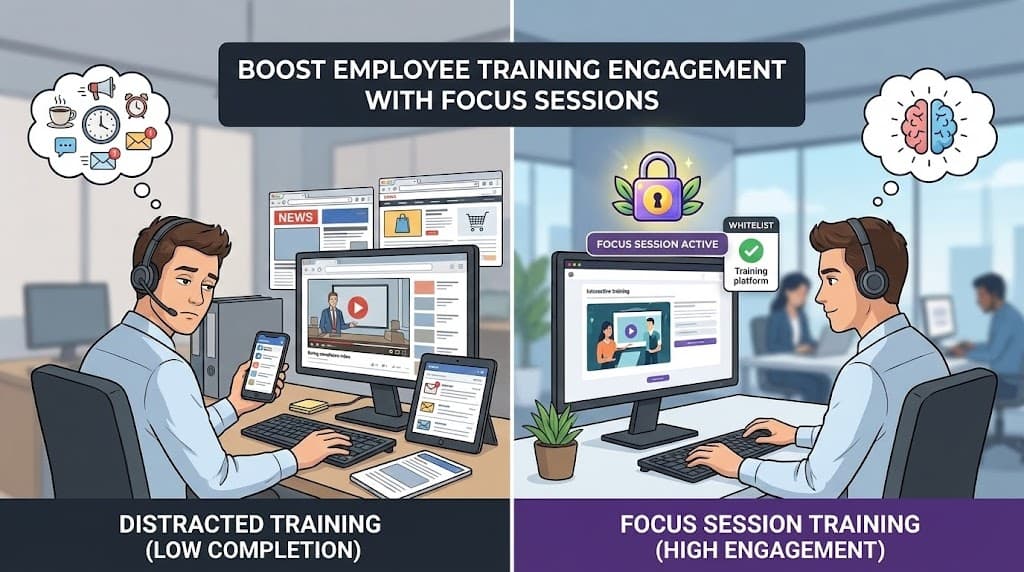
Let's be honest: most employees treat mandatory training as background noise.
They click "play" on the compliance video, minimize the window, and catch up on emails. They click through the quiz answers they've memorized from last year. They technically "complete" the training without learning anything.
As an HR professional or L&D manager, you know this is a problem. Training exists for a reason—whether it's security awareness, harassment prevention, or onboarding new hires. When employees don't actually engage, the organization is at risk.
So how do you get genuine engagement without turning into the training police?
Focus sessions offer a middle ground: structure and accountability without invasive surveillance.
The Corporate Training Completion Problem
The numbers are stark:
- 70% of employees admit to multitasking during virtual training
- Only 12% say they apply what they learn in training to their jobs
- Average completion rates for optional training hover around 20-30%
Even mandatory training with 100% "completion" rates often means 0% actual engagement.
Why does this happen?
Training Feels Like a Checkbox
Employees see mandatory training as something to get through, not learn from. The goal becomes "click through fast enough to get back to real work."
No Accountability for Engagement
Most LMS platforms track whether someone finished—not whether they paid attention. An employee can pass a quiz by clicking through at random until they get lucky.
Competing Priorities
During a 30-minute training module, employees receive emails, Slack messages, and calendar reminders. The training can't compete with urgent work demands.
The Content Isn't Great
Let's be fair: a lot of corporate training is boring. Generic videos, robotic narration, obvious scenarios. Employees check out because the content doesn't respect their time.
Why Employees Tune Out
Understanding why employees disengage helps us design better solutions.
Mandatory = resentment: When something is forced, humans naturally resist. "I have to do this" triggers a different mindset than "I want to learn this."
Low perceived value: If employees don't see how the training helps them, they won't invest attention. "This security training won't apply to me" (until they click on a phishing link).
No immediate consequences: Unlike a live meeting where someone might call on you, training lets you disengage with zero immediate risk. The consequences only show up later—if at all.
Optimized for completion, not learning: Most training is designed to be "completable" in the shortest time possible. Speed-running is the natural response.
Focus Sessions for Training: How It Works
A focus session creates a dedicated time block where employees engage with training without distractions. Here's the concept:
-
Schedule training as an event: Instead of "complete by Friday," it's "Tuesday 2-3 PM: Security Training Focus Session"
-
Create a focus room: Employees join a session where only the training platform is accessible
-
Block distractions automatically: Email, Slack, news, social media—all blocked during the session
-
Monitor engagement in real-time: Administrators can see who's focused and who's wandering off-task
-
Debrief and discuss: After the training, a brief discussion reinforces key points
The key insight: environment shapes behavior. When the only thing you can do is engage with the training, you engage with the training.
Compliance Training Use Cases
Focus sessions work particularly well for compliance training, where engagement isn't just nice-to-have—it's legally important.
Security Awareness Training
The problem: Employees click through phishing simulations without reading. When a real attack comes, they fall for it.
Focus session approach:
- Schedule a 45-minute focus session
- Whitelist only the security training platform
- Include interactive elements (simulated phishing decisions) that require attention
- Follow up with a team discussion on what they learned
Outcome: Employees who actually read the scenarios are better at spotting real threats.
Harassment Prevention Training
The problem: This sensitive topic requires genuine reflection. Clicking through a video doesn't build the awareness needed.
Focus session approach:
- Create a distraction-free environment for the content
- Allow time for scenario-based exercises that require thought
- Enable anonymous discussion or Q&A after the session
Outcome: Employees actually consider the scenarios rather than tuning out.
HIPAA / Data Privacy Training
The problem: Healthcare and data privacy regulations are complex. Surface-level completion doesn't build real understanding.
Focus session approach:
- Whitelist training platform plus relevant policy documents
- Include knowledge checks that require actual comprehension
- Track violations to identify who might need additional support
Outcome: Staff who genuinely understand compliance requirements, not just those who passed a quiz.
New Hire Onboarding
The problem: New employees are overwhelmed. They're trying to set up email, meet their team, and complete 8 hours of onboarding training simultaneously.
Focus session approach:
- Dedicate specific blocks for training (not "do it whenever")
- Remove the temptation to multitask during onboarding content
- Let new hires focus on one thing at a time
Outcome: Better retention of company culture, policies, and role-specific information.
Reporting: Proving Training Engagement to Auditors
For regulated industries, proving that training happened isn't enough. You need to demonstrate genuine engagement.
Focus sessions provide documentation beyond simple completion:
Attendance records: Who joined the session and when
Engagement metrics: What percentage of time was spent focused on training vs. off-task
Violation logs: Any attempts to access non-whitelisted sites (without invasive monitoring of what they typed or said)
Session timestamps: Proof that training was completed during a focused block, not clicked through in 2 minutes
This data helps answer auditor questions like:
- "How do you ensure employees are engaging with training?"
- "What controls are in place to prevent employees from bypassing training?"
- "Can you demonstrate that training was more than a checkbox exercise?"
Setting Up Training Sessions: A Practical Guide
Here's how to implement focus sessions for corporate training using Focus Room:
Step 1: Schedule Dedicated Training Time
Don't leave training as "complete by end of quarter." Instead:
- Block calendar time specifically for training
- Send invites with clear expectations
- Make it a team activity, not individual homework
Step 2: Create Your Focus Room
Set up a room with a focused whitelist:
For LMS-based training:
Your LMS domain (Workday, Cornerstone, etc.)
The specific training content (if externally hosted)
Nothing else
For video-based training:
Your training video platform
Maybe note-taking app (if encouraged)
Nothing else
Step 3: Communicate Expectations
Tell employees:
- What: "We're doing security training as a team"
- Why: "This helps us all stay safe—and it's required for compliance"
- How: "You'll join a focus session where only the training is accessible"
- What's monitored: "We'll see if anyone accesses non-training sites, but not what you type or say"
Transparency prevents resentment.
Step 4: Run the Session
- Start with a brief intro (5 min): why this training matters
- Training content (30-60 min): everyone focuses together
- Wrap up (5-10 min): key takeaways, Q&A, discussion
Step 5: Review and Follow Up
Check engagement metrics:
- Who was focused throughout?
- Who had multiple violations? (They might need a check-in)
- Was the content too long for a single session?
Use data to improve future training sessions.
Balancing Trust and Accountability
The biggest concern with focus monitoring in corporate settings: "This feels like Big Brother."
Here's how to get the balance right:
Do: Be Transparent
Explain exactly what's monitored (site access) and what isn't (webcam, keystrokes, screen content). No surprises.
Do: Explain the Reasoning
"We're using this because engagement matters for compliance and for your professional development. It's not about distrust—it's about creating an environment where focus is easier."
Do: Apply It Equally
If leadership mandates focus sessions for compliance training, leadership should participate too. Nothing undermines trust like "rules for thee, not for me."
Don't: Use It for General Surveillance
Focus sessions are for specific training events—not all-day monitoring. The goal is focused blocks, not constant surveillance.
Don't: Punish Minor Violations
If someone accidentally clicked their email out of habit, that's human. Use violation data to identify patterns, not to write people up for single incidents.
Don't: Skip the Human Element
Focus sessions work best when combined with discussion, Q&A, and manager follow-up. Technology supports engagement—it doesn't replace genuine learning culture.
Getting Started
Ready to improve training engagement at your organization? Here's a quick start:
For a pilot:
- Pick one upcoming mandatory training (security awareness is a good start)
- Schedule it as a focus session instead of "complete by X date"
- Create a Focus Room with just the training platform whitelisted
- Run the session with your team
- Gather feedback and review engagement metrics
What to measure:
- Engagement rate during the session
- Quiz/assessment scores (compared to previous click-through completions)
- Employee feedback on the format
- Time to completion (focused training is often faster overall)
Scaling up: Once you've proven the concept, expand to:
- All compliance training
- New hire onboarding
- Professional development sessions
- Certification prep
The ROI of Engaged Training
When employees actually engage with training:
- Reduced risk: Security training that sticks means fewer successful phishing attacks
- Better compliance: Auditors see genuine engagement, not just checked boxes
- Improved retention: Employees who understand onboarding content onboard faster
- Higher satisfaction: Focused training respects employees' time better than "click through whenever"
The alternative—training that's "completed" but not learned—is a waste of everyone's time and budget.
Ready to transform your training from checkbox to genuine learning?
Sign up for Focus Room and run your first focus session. It's free to get started.
Questions about corporate training use cases? Email us: [email protected]
— The Focus Room Team