
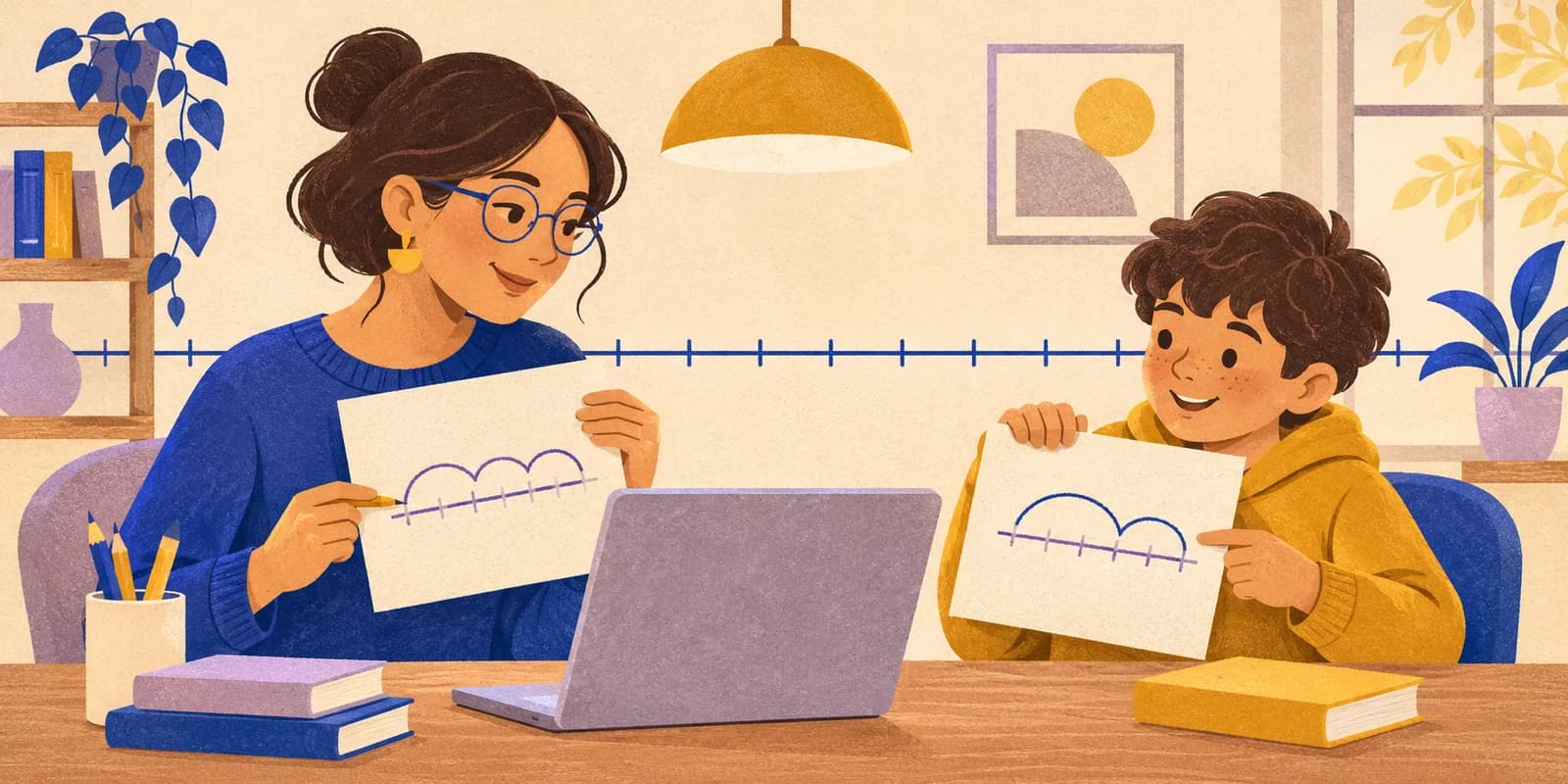
Write −2 + (−3) and −2 − (−3) side by side. Give the learner a number line and ask them to predict which way each arrow will point before they calculate. Both expressions start at −2. The first ends at −5 and the second ends at 1. The difference between those arrows gives you something specific to teach.
This 25-minute online tutoring lesson is for learners who can count across zero and are starting to add and subtract signed integers. By the end, ask them to name the starting point, explain the direction, and verify a subtraction with addition. Allow five minutes for setup and the warm-up, eight for modeling, seven for guided practice, and five for the independent check. The approach fits grade 7 standard 7.NS.A.1, which includes representing these operations on horizontal or vertical number lines. Massachusetts Standards Navigator
Set up one line and check where zero goes
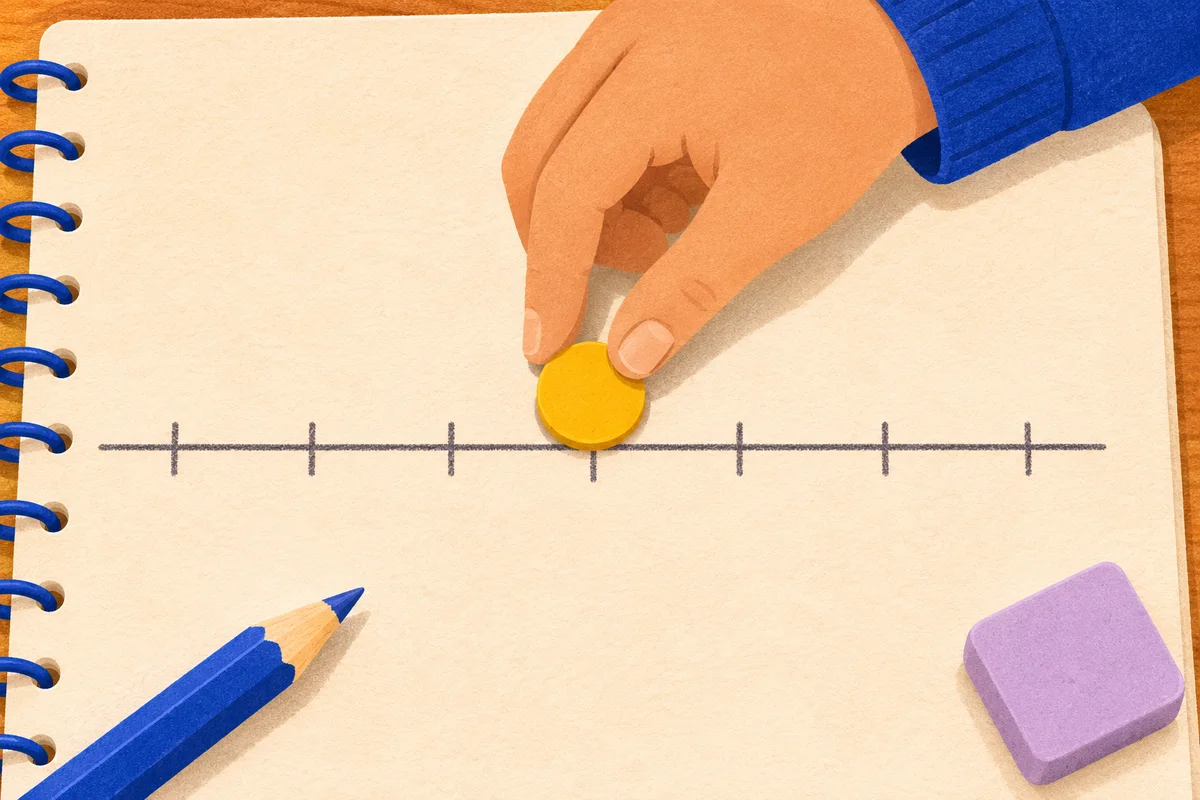
Put a horizontal line from −8 to 8 on a shared whiteboard or document. Use evenly spaced marks, with one unit between neighbors, and label zero. Keep a copy with space for an arrow above the line. Learners can draw on paper, annotate a copy, or describe the start, move, and end aloud. Put the equations in chat as text so they can reread the signs.
Spend the first few minutes checking the scale. Ask the learner to locate −4 and −1, tell you which is greater, and say how far apart they are. Expect −1 to be farther right and a distance of three units. If they count four, trace the three gaps together. If they put −4 to the right of −1, locate both relative to zero before introducing an operation.
Model one addition and one subtraction
For −2 + (−3), put a dot at −2. Adding −3 means moving three units left. Ask the learner to name the tick reached at each step. They should say −3, −4, then −5. Write −2 + (−3) = −5 below the drawing.
For −2 − (−3), return to −2. Subtracting a number is equivalent to adding its opposite. The opposite of −3 is 3, so rewrite the expression as −2 + 3. Move three units right through −1 and 0 to 1.
To check that result, ask which number you could start from and then add −3 to land on −2. Start at 1 and move three units left. That gives 1 + (−3) = −2. Draw this check separately so the original subtraction arrow and the check arrow have clear labels. Illustrative Mathematics uses both the missing-addend interpretation and adding the opposite to connect subtraction with addition. Illustrative Mathematics, Subtracting Rational Numbers
Ask for the direction before the answer
Give the learner 3 + (−5) and 3 − (−5). Ask for the starting point, the direction and number of units, and then the endpoint. Both moves start at 3 and cover five units. Addition lands at −2. Subtraction lands at 8.
Use the explanation to decide what to practice next.
- Both arrows point left. Ask the learner to circle the subtraction operation in the second expression and underline the signed number in parentheses. Ask them to say its opposite and rewrite the expression before moving.
- The arrow starts at zero or at −5. Ask them to put a dot on the first number before drawing the arrow. Then ask which part of the rewritten expression determines the move.
- The arrow points the right way but ends one unit short. Have them draw one arc for each gap and count the arcs. Pointing at the start represents zero movement.
- The answer is right but the explanation is unclear. Ask them to use the endpoint in an addition equation that recovers the starting number.
End with an independent check
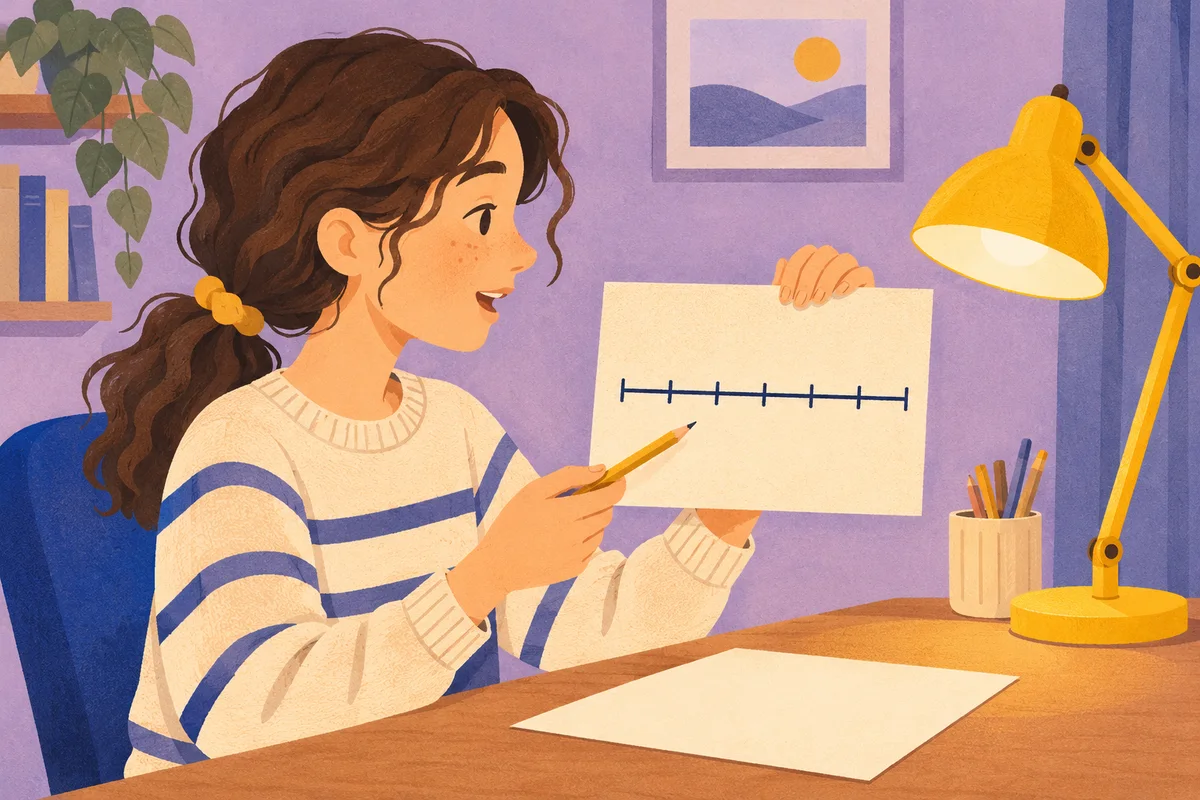
Give the learner −6 − (−4) and ask for the equivalent addition, direction, endpoint, and check. A complete response gives −6 + 4 = −2, four units right from −6, and −2 + (−4) = −6. Here the arrow goes right and still ends left of zero. Ask what determined the direction and what determined the sign of the result.
If the learner explains the direction but miscounts the gaps, start the next lesson with a short spacing check. If they can move correctly only after you rewrite the subtraction, use another pair such as −1 − 2 and −1 − (−2). Ask them to write the equivalent additions themselves before drawing either arrow. For another tutoring lesson built around a model and a short independent check, see the worked ratio examples.
Keep the practice resources within reach
If your learners use a browser-based whiteboard, test the board, call link, and sign-in flow in advance. Give them the paper-and-chat version as an alternative. When using Focus Room, add the required site hostnames to the room allowlist. The extension checks hostnames and their subdomains in the participating browser during the active session. Review the learner’s explanation in your whiteboard, chat, or call. Focus Room student joining guide
If you want to try the browser setup for your next lesson, create a Focus Room account and test the resource links before the learner joins.